I’ve been working on my feet since I was in high school; that’s actually what brought me to Alsara. I just really started to have some pain in my legs, and my lifestyle was really changed. I wasn’t as active as I used to be, and I knew I had to do something about it.
I had swelling in my feet, pain down the leg. I had a vein that was bulging out; it was so ugly; a lot of itching across that vein. And, then, I’d be dragging my feel by the end of the day where I had just a weight to my legs that I couldn’t get past. It really slowed me down to where, by the time I was done working, I was done for the day. There was no going out with friends. There was no being active. It was ‘let’s go home and kick our feet up’ and finish the night.
I had actually saw you all at a little convention, and you had a booth out and I got some information there. I had been attending for a work event and decided maybe this is something I should look into for myself.
First impression was fantastic. Everyone was so nice, so informative. They really sat down and went through each symptom with me, and what we could do, different procedures that might help, and what my odds were of it completely fixing it or what percentage better it would be.
I was terrified coming in. I hate needles and I knew that was going to be a big part of it, so I was definitely scared walking in the door. The staff was so friendly and really helped calm me down, and let me know it’s not going to be bad – you will get through it. They sat with me and talked me through the entire procedure. Really no pain during the procedure at all. Afterwards, I was totally fine. I went right back to work immediately following my appointment with no downtime whatsoever.
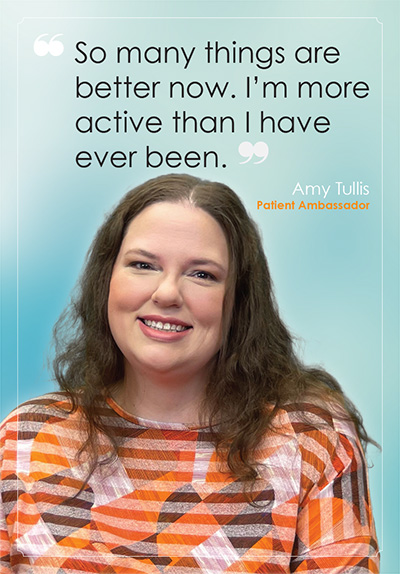
So many things are better now. I go out walking daily. I took a vacation for the first time in years where I actually go to go hiking up a mountain. I bought a house with stairs that I never would have considering doing, before, because stairs were not an option at the end of the day! So I’m definitely more active than I have ever been.
[Dr. Gupta] is so nice and so knowledgeable. He really takes the time to sit down and go through everything with you, and he never makes you feel stupid about asking questions. He will make sure you understand fully before you walk out the door. The staff is fantastic, as well. They know you by name when you walk in the door; you’re not just another patient. They are always asking you how you’re doing. They’ll remember what you were doing months ago at your prior appointment, and see how things have been since then.
I recommended my mother to come in and see everyone here.
I would have never thought this would be something I’d be doing at my age. I always thought ‘vein procedures… that’s something grandmas do’. But, no, definitely something I’m so glad I did.
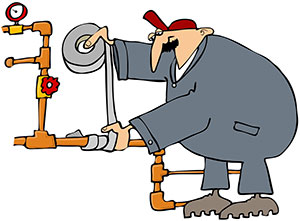
Veins, acting as “pipes,” have to frequently work against gravity to push blood back towards the heart especially when we sit or stand. These veins have valves that assist in the one-way flow back to the heart. Further, leg muscles especially calf muscles act like a pump much like a sump pump in our basement.
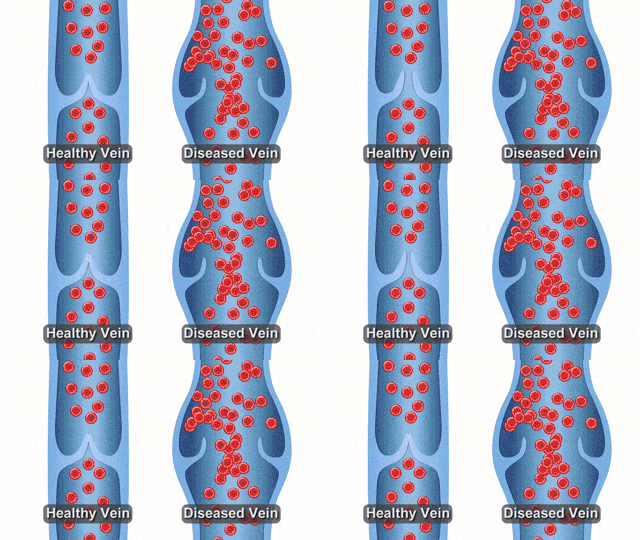
Over time, compounded by factors such as genetic predisposition, pregnancies, hormonal changes, prolonged sitting or standing, lifting weights, and age, some veins fail. Unable to move forward, blood begins to backtrack and pool in the legs causing the familiar symptoms of heaviness, achiness, and tiredness in legs, particularly in the evenings. Increased pressure on the vein walls makes them “gnarly” or varicose. Some veins that are close to the surface of the skin can be seen from the outside as ropy veins or spider veins.
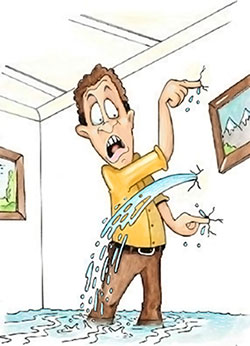
Venous hypertension (increased pressure of the blood in failed veins) predisposes you to profuse bleeding. Elevated pressure causes fluid from veins to leak out into surrounding space much like flooding in our basement when a pipe breaks.
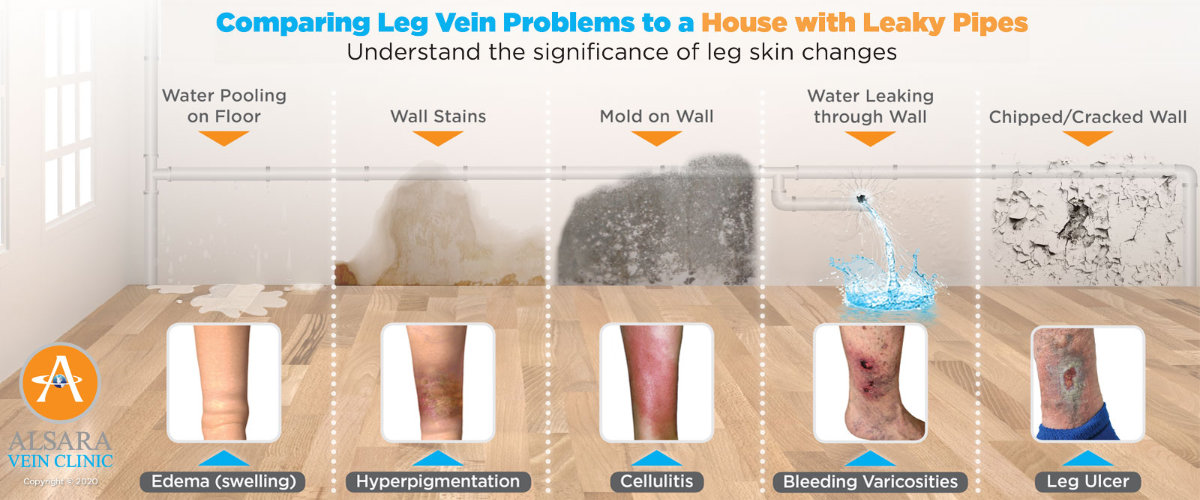
Remember that the blood in veins is deoxygenated (has “low” oxygen content) and replete with waste products. This blood needs to be sent back to the heart where it can be enriched and put back in circulation. When there is an increased buildup of venous blood in the legs, patients may notice itching, burning, leg cramps (charley horses), and restlessness. Persistent stasis (pooling) causes hyperpigmentation (discoloration of the skin due to deposition of the hemosiderin pigment from the breakdown of red blood cells), cellulitis (skin infection), thrombosis (blood clots), and poorly healing ulcers (sores) in the legs. This is comparable to staining on the walls from leaky pipes, growth of mold, cracks in the walls, and eventually its breakdown.
These unhealthy veins in the legs are unnecessary. In the past, they were removed surgically. Modern treatment options are much easier, safer, and very effective with no downtime. Almost all insurance including Medicare offers coverage for symptomatic varicose veins. Contact Alsara Vein Clinic at 816-396-0245 to set up a Consultation today.
How were you affected by your legs previously? What couldn't you do? How has that changed now?
My legs would cramp towards the end of the day after being on my feet all day. [After treatment], I can now make it through a 12 hour day without pain.
What improvements have you seen in your legs?
Heaviness seems to be gone and cramping is improving daily.
Additional Comments: What did you appreciate? What makes us different than other medical clinics? What could we have done better to exceed your expectations? What changes would you like to see?
The staff was amazing throughout the whole clinic.
My husband had met Dr. Gupta through a real estate appointment & recommended him to me.
What symptoms were you experiencing?
Extreme itching of the skin on the lower right leg, ankle swelling. No pain, but the itching was intense for months.
How were you affected by your legs previously? What couldn't you do? How has that changed now?
I was never prevented from normal activities. The itching did interfere with my sleep, however.
What improvements have you seen in your legs?
Swelling eliminated. Itching ceased. Skin affected has cleared up – no inflammation..
Additional Comments: What did you appreciate? What makes us different than other medical clinics? What could we have done better to exceed your expectations? What changes would you like to see?
Appointments were promptly kept on time. The staff is courteous & professional. Kati's the best. Dr. Gupta always clearly explained my condition, office treatments & home care expectations. No changes [needed].
Dr. Gupta is a very kind, professional with his patients [who are] always put first.
Billing/Patient Account Services:
Very good.
Call Center/Patient Service Center:
Very good.
What made you choose us?
Went to Dr. Gupta's seminar. Very informative.
What symptoms were you experiencing?
Itching, pigmented skin, some swelling [in legs].
How were you affected by your legs previously? What couldn't you do? How has that changed now?
Less swelling, pigmented areas more feathered, still some itching.
What improvements have you seen in your legs?
See previous answer.
Additional Comments: What did you appreciate? What makes us different than other medical clinics? What could we have done better to exceed your expectations? What changes would you like to see?
Excellent Dr. Gupta & staff always looking out for the best interest of the patient. Friendly & very helpful to answer any questions. Dr. Gupta takes his time with you and explains procedures in a "down to earth" fashion. Very caring!.
President Donald Trump was recently diagnosed with Chronic Venous Insufficiency (CVI). His diagnosis has sparked renewed interest in this common yet often overlooked condition. Many patients are now asking important questions: What is CVI? Is it serious? Who gets it? How is it treated? Let’s dive right in.
Chronic Venous Insufficiency (CVI) is a medical condition in which the veins in the legs don’t function properly, making it difficult to pump blood back to the heart. This leads to circulation problems and a variety of leg symptoms.
In the early stages, symptoms may be subtle such as heaviness, fatigue, aching, throbbing, itching, or burning in the legs. As the condition progresses, due to inadequate blood flow to calf muscles patients may experience leg cramps (often called “Charley horses”) or restlessness at night (Restless Leg Syndrome).
Without treatment, CVI can worsen and lead to leg swelling, skin discoloration, bleeding varicose veins, recurrent skin infections, blood clots and poorly healing sores (ulcers)
How Common is CVI?
CVI is extremely common, affecting 10–35% of adults in the U.S. Both men and women are at risk, but women often develop symptoms earlier due to pregnancies and hormonal changes. In fact, nearly 40% of women over age 50 have some degree of CVI.
Risk factors include family history of vein disease, age and prolonged standing or sitting
Treatment of CVI
In the past, treatment for CVI often required invasive vein stripping surgery in a hospital, followed by a long and painful recovery. Thankfully, modern medicine has transformed vein care.
Today, CVI can be treated in the comfort of an office setting with minimally invasive procedures. Diseased veins are safely closed, restoring healthy circulation. Patients typically return to normal activities immediately with no downtime, and minimal discomfort. Many notice improvements in their legs as soon as the next day.
A quick, painless duplex ultrasound can diagnose CVI, and your vein specialist will review personalized treatment options. Almost all insurance plans including Medicare cover treatment of symptomatic vein disease.
Call Alsara Vein Clinic today at 816-396-0245 for a Consultation. We offer same-day appointments.
During the initial stages of varicose veins, patients usually have mild symptoms, which are experienced more toward the end of the day. The onset of symptoms is often very subtle, so much so that many people forget how their legs felt before they had problems. As the condition worsens, symptoms become more noticeable.
The initial signs and symptoms may include:
Aching
Burning or numbness
Cramping or 'Charley horse'
Heaviness
Itching
Leg pain
Restlessness in legs
Tiredness
Swelling in feet ankles and calves
Left untreated, may result in skin discoloration, bleeding veins, sores that heal poorly, and blood clots.
Over time, the symptoms will worsen and could result in skin discoloration, sores, blood clots, frequent skin infections, and bleeding.
It might be surprising to learn that restless leg syndrome, leg cramps, swollen ankles, ulcers, varicose veins, and spider veins could all be symptoms of vein disease. We've helped thousands achieve relief with in-office treatments.
Schedule your Consultation today with Alsara Vein Clinic.
Left untreated, they continue to worsen and turn into a serious problem.
Maybe you’ve seen the blue or purple squiggly veins on your legs that look like lines on a roadmap and wondered how to get rid of them. Maybe you are experiencing pain, cramps, restlessness, or have sores on your legs, and you were told by your Primary Care Provider that you have varicose veins. Perhaps you wondered “What the heck are varicose veins anyway” and “How do I get rid of them?”
What is a Varicose Vein (and CVI)?
In simplest terms, varicose veins are faulty blood vessels that have become overstretched and swollen with blood.
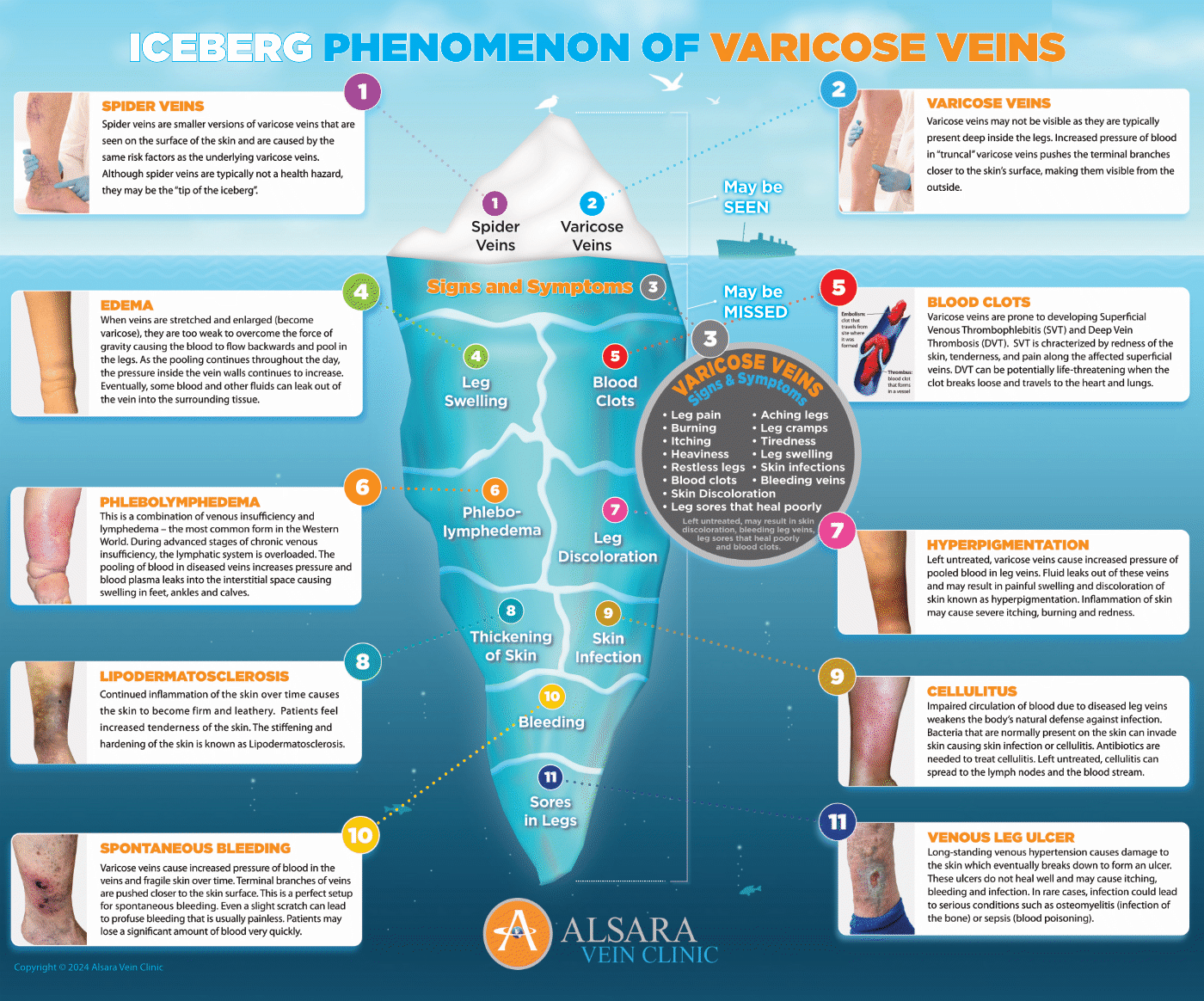
When your heart beats, it pumps blood through arteries to every part of your body carrying oxygen and essential nutrients. Since you have a limited amount of blood (about 5 liters in an adult), the deoxygenated blood returns to the heart via countless veins in your body. The veins in your legs are farthest from the heart and must work against gravity to push blood back to the heart. Compounded by other risk factors, some veins wear out over time and become “varicose”. The pooling of blood in varicose veins may cause symptoms such as heaviness, tiredness, itching, burning, cramping, restlessness and pain. Left untreated, the increased pressure of blood in the leg veins can leak out, causing problems such as edema, skin discoloration, sores in legs that heal poorly, and frequent skin infections. This condition is called Chronic Venous Insufficiency (CVI).
Who gets them?
Although varicose veins affect both men and women, they are slightly more common in women who tend to have them at an earlier age. This may also have to do with the fact that men are less inclined to seek timely medical care. Hence, it is not a surprise that men have more advanced stages of varicose veins and CVI by the time they see a vein specialist compared to women. People in general are more likely to get them as they get older.
Frequently there is a genetic predisposition to vein problems. That means that if your mom or your sister has them, you are more likely to also have them. Things that put pressure on your legs and feet — like being overweight or standing for a long time, every day, without exercise — can also cause varicose veins. Pregnancies also make veins worse due to increased pressure of the uterus and the extra blood volume.
Do I need these veins? How do I get rid of them?
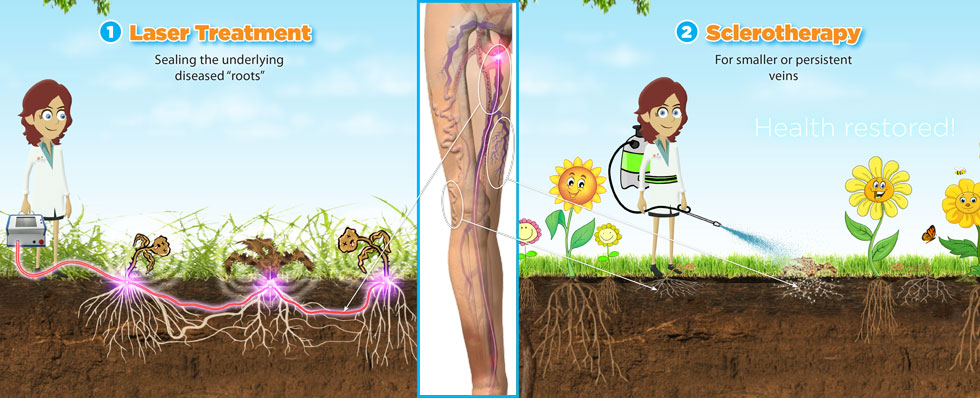
Once a vein is varicose, it is a diseased blood vessel much like a “weed” in your yard. Just like weeds compete for space and nutrients in your yard (and are formidable competitors!), varicose veins have weakened walls that facilitate easy entry of blood but instead of pushing the blood back in circulation, the blood tends to pool in them causing a wide variety of problems including life-threatening blood clots.
In the past, varicose veins were “stripped” much like pulling weeds from the yard. This was a painful, imprecise, and invasive surgery with significant downtime, scarring, and risk of complications. Even worse, many patients required additional treatment due to other veins rapidly becoming varicose.
In the last 15 to 20 years, our increased understanding of venous disease, modern tools available for accurate diagnosis, and minimally invasive treatments have revolutionized how we treat vein problems in legs. After your vein specialist has performed a detailed ultrasound scan of your legs, he/she will create a “road map”. Then, using tools such as Endovenous Laser Ablation (EVLA), your Vein Specialist can seal the underlying varicose veins at their source, much like closing the large root of weeds from the inside. Any smaller, persistent veins can then be treated using injection sclerotherapy that is analogous to using a weed killer in your yard. Some unsightly varicose veins are removed by microphlebectomy, the careful removal of unwanted veins through tiny openings using very fine instruments without the need for sutures or risk of scarring.
Current treatments are very safe, effective, and provide long-lasting relief without any downtime or painful recovery. Since varicose veins and CVI are serious problems, almost all health insurance companies, including Medicare and Medicaid, offer coverage for necessary scans and treatments.
Contact Alsara Vein Clinic at 816-396-0245 to set up a Consultation today.

 I’ve been working on my feet since I was in high school; that’s actually what brought me to Alsara. I just really started to have some pain in my legs, and my lifestyle was really changed. I wasn’t as active as I used to be, and I knew I had to do something about it.
 Click to view large image
 Unable to move forward, blood begins to backtrack and pool in the legs causing the familiar symptoms of heaviness, achiness, and tiredness in legs, particularly in the evenings. Increased pressure on the vein walls makes them “gnarly” or varicose. Some veins that are close to the surface of the skin can be seen from the outside as ropy veins or spider veins.
 Remember that the blood in veins is deoxygenated (has “low” oxygen content) and replete with waste products. This blood needs to be sent back to the heart where it can be enriched and put back in circulation. When there is an increased buildup of venous blood in the legs, patients may notice itching, burning, leg cramps (charley horses), and restlessness. Persistent stasis (pooling) causes hyperpigmentation (discoloration of the skin due to deposition of the hemosiderin pigment from the breakdown of red blood cells), cellulitis (skin infection), thrombosis (blood clots), and poorly healing ulcers (sores) in the legs. This is comparable to staining on the walls from leaky pipes, growth of mold, cracks in the walls, and eventually its breakdown.



 Chronic Venous Insufficiency (CVI) is a medical condition in which the veins in the legs don’t function properly, making it difficult to pump blood back to the heart. This leads to circulation problems and a variety of leg symptoms.

 When your heart beats, it pumps blood through arteries to every part of your body carrying oxygen and essential nutrients. Since you have a limited amount of blood (about 5 liters in an adult), the deoxygenated blood returns to the heart via countless veins in your body. The veins in your legs are farthest from the heart and must work against gravity to push blood back to the heart. Compounded by other risk factors, some veins wear out over time and become “varicose”. The pooling of blood in varicose veins may cause symptoms such as heaviness, tiredness, itching, burning, cramping, restlessness and pain. Left untreated, the increased pressure of blood in the leg veins can leak out, causing problems such as edema, skin discoloration, sores in legs that heal poorly, and frequent skin infections. This condition is called Chronic Venous Insufficiency (CVI).