Many patients now recognize that varicose veins may not be visible from the outside. Most of our patients report experiencing tiredness, cramping (charley horse), restlessness, or swelling in the legs. Those whose condition has not reached one of the advanced stages often wonder if they are at increased risk of anything that could be limb or life-threatening.
At least one-third of our patients clearly have signs of advanced venous insufficiency – when varicose veins have progressed to a point where the chronic pooling of blood (stasis) in the legs causes skin changes. They may notice skin discoloration, thickening or hardening of the skin, recurrent skin infections, bleeding that can be profuse, and poorly healing sores in the legs. In addition, varicose veins may be an early warning sign of potentially deadly blood clots.
We routinely see patients with blood clots. Some are referred by their primary care providers and others present themselves with concerns about blood clots. Yet there are many patients who are surprised to find that they have a blood clot when we examine them using duplex ultrasound.
Blood clots are far more common than most people think. Serena Williams and Hillary Clinton are among the dozens of celebrities who have suffered consequences due to blood clots. James “Jimmy” Stewart from the movie It’s a Wonderful Life and NBC journalist David Bloom lost their lives from blood clots. David Bloom’s wife, Melonie Bloom, has devoted her life to raising awareness of thrombosis.
The association between varicose veins and deep vein thrombosis (DVT) was demonstrated in a landmark Taiwanese study published in JAMA (Journal of the American Medical Association). Reviewing the health records of over 425,000 adults, the study found a higher rate of pulmonary embolism (when a blood clot in the leg breaks off and travels to the lung) and peripheral artery disease in patients with varicose veins.
Varicose veins increase the risk of deep vein thrombosis (DVT) by five times
DVT is a clot in the legs, which can lead to amputation or even death
Varicose veins make people twice as likely to develop a pulmonary embolism
Varicose veins double the risk of peripheral artery disease, which reduces blood flow
Varicose veins are veins with weakened walls that fail and cause pooling of blood in the legs. Patients with varicose veins are known to have increased levels of inflammatory and pro-thrombotic markers. These patients have a considerably high risk of forming blood clots in their legs.
Not all clots are serious, but they often tell us about an underlying problem such as impaired blood flow that can lead to greater problems down the road. As Dr. Chang, the lead author of the Taiwanese study stated, “varicose veins deserve careful monitoring and early evaluation”.
Left untreated, they continue to worsen and turn into a serious problem.
Maybe you’ve seen the blue or purple squiggly veins on your legs that look like lines on a roadmap and wondered how to get rid of them. Maybe you are experiencing pain, cramps, restlessness, or have sores on your legs, and you were told by your Primary Care Provider that you have varicose veins. Perhaps you wondered “What the heck are varicose veins anyway” and “How do I get rid of them?”
What is a Varicose Vein (and CVI)?
In simplest terms, varicose veins are faulty blood vessels that have become overstretched and swollen with blood.
When your heart beats, it pumps blood through arteries to every part of your body carrying oxygen and essential nutrients. Since you have a limited amount of blood (about 5 liters in an adult), the deoxygenated blood returns to the heart via countless veins in your body. The veins in your legs are farthest from the heart and must work against gravity to push blood back to the heart. Compounded by other risk factors, some veins wear out over time and become “varicose”. The pooling of blood in varicose veins may cause symptoms such as heaviness, tiredness, itching, burning, cramping, restlessness and pain. Left untreated, the increased pressure of blood in the leg veins can leak out, causing problems such as edema, skin discoloration, sores in legs that heal poorly, and frequent skin infections. This condition is called Chronic Venous Insufficiency (CVI).
Who gets them?
Although varicose veins affect both men and women, they are slightly more common in women who tend to have them at an earlier age. This may also have to do with the fact that men are less inclined to seek timely medical care. Hence, it is not a surprise that men have more advanced stages of varicose veins and CVI by the time they see a vein specialist compared to women. People in general are more likely to get them as they get older.
Frequently there is a genetic predisposition to vein problems. That means that if your mom or your sister has them, you are more likely to also have them. Things that put pressure on your legs and feet — like being overweight or standing for a long time, every day, without exercise — can also cause varicose veins. Pregnancies also make veins worse due to increased pressure of the uterus and the extra blood volume.
Do I need these veins? How do I get rid of them?
Once a vein is varicose, it is a diseased blood vessel much like a “weed” in your yard. Just like weeds compete for space and nutrients in your yard (and are formidable competitors!), varicose veins have weakened walls that facilitate easy entry of blood but instead of pushing the blood back in circulation, the blood tends to pool in them causing a wide variety of problems including life-threatening blood clots.
In the past, varicose veins were “stripped” much like pulling weeds from the yard. This was a painful, imprecise, and invasive surgery with significant downtime, scarring, and risk of complications. Even worse, many patients required additional treatment due to other veins rapidly becoming varicose.
In the last 15 to 20 years, our increased understanding of venous disease, modern tools available for accurate diagnosis, and minimally invasive treatments have revolutionized how we treat vein problems in legs. After your vein specialist has performed a detailed ultrasound scan of your legs, he/she will create a “road map”. Then, using tools such as Endovenous Laser Ablation (EVLA), your Vein Specialist can seal the underlying varicose veins at their source, much like closing the large root of weeds from the inside. Any smaller, persistent veins can then be treated using injection sclerotherapy that is analogous to using a weed killer in your yard. Some unsightly varicose veins are removed by microphlebectomy, the careful removal of unwanted veins through tiny openings using very fine instruments without the need for sutures or risk of scarring.
Current treatments are very safe, effective, and provide long-lasting relief without any downtime or painful recovery. Since varicose veins and CVI are serious problems, almost all health insurance companies, including Medicare and Medicaid, offer coverage for necessary scans and treatments.
Contact Alsara Vein Clinic at 816-396-0245 to set up a Consultation today.
Large, bulging varicosities that appear on the skin surface as ropey veins are usually branches of deeper saphenous veins inside the leg. In the past, the saphenous vein was typically treated first using thermal ablation such as Endovenous Laser Ablation (EVLA). Any remaining varicosities that were closer to the surface of the skin were then typically sealed from the inside by sclerotherapy.
At times, unwanted veins were too large for sclerotherapy and had to be removed by microphlebectomy. The revolutionary VenaSeal™ offers an opportunity to seal all affected varicosities (veins that are deeper inside the leg and those closer to the surface of the skin) in one session without undue risk of thermal injury or pain during the procedure. The FDA-approved VenaSeal™ involves use of a medical superglue (cyanoacrylate) that permanently seals the unwanted veins from inside. Even better, the prolonged use of stockings after the procedure is not required. Once sealed, the diseased veins are gradually absorbed by the body. Your Vein Specialist will help you decide if this novel treatment would be suitable for you.
Now you can get rid of unwanted ropey veins in one hour while you select a pair of shorts online that match your new legs! Call us at 816-396-0245 for a Consultation.
Kati so friendly & gentle & explains what she was doing.
Provider/Doctor/Nurse Practitioner:
Dr. Gupta very polite & explains the procedure.
What made you choose us?
Primary doctor sent me here.
What symptoms were you experiencing?
Swelling & blood clot in the right leg, swelling in the left leg.
How were you affected by your legs previously? What couldn't you do? How has that changed now?
Couldn't do what I wanted because my leg wouldn't let me. I didn't realize there was something wrong with them.
What improvements have you seen in your legs?
Walk a whole lot better, pick legs up easier; less swelling. Legs don't give out on me. Must have had problems for years & didn't know it.
Additional Comments: What did you appreciate? What makes us different than other medical clinics? What could we have done better to exceed your expectations? What changes would you like to see?
Very friendly and explained things to us & let us watch on screen. Didn't spend any time in the waiting room. They seem to get to you right away.


 Varicose veins increase the risk of deep vein thrombosis (DVT) by five times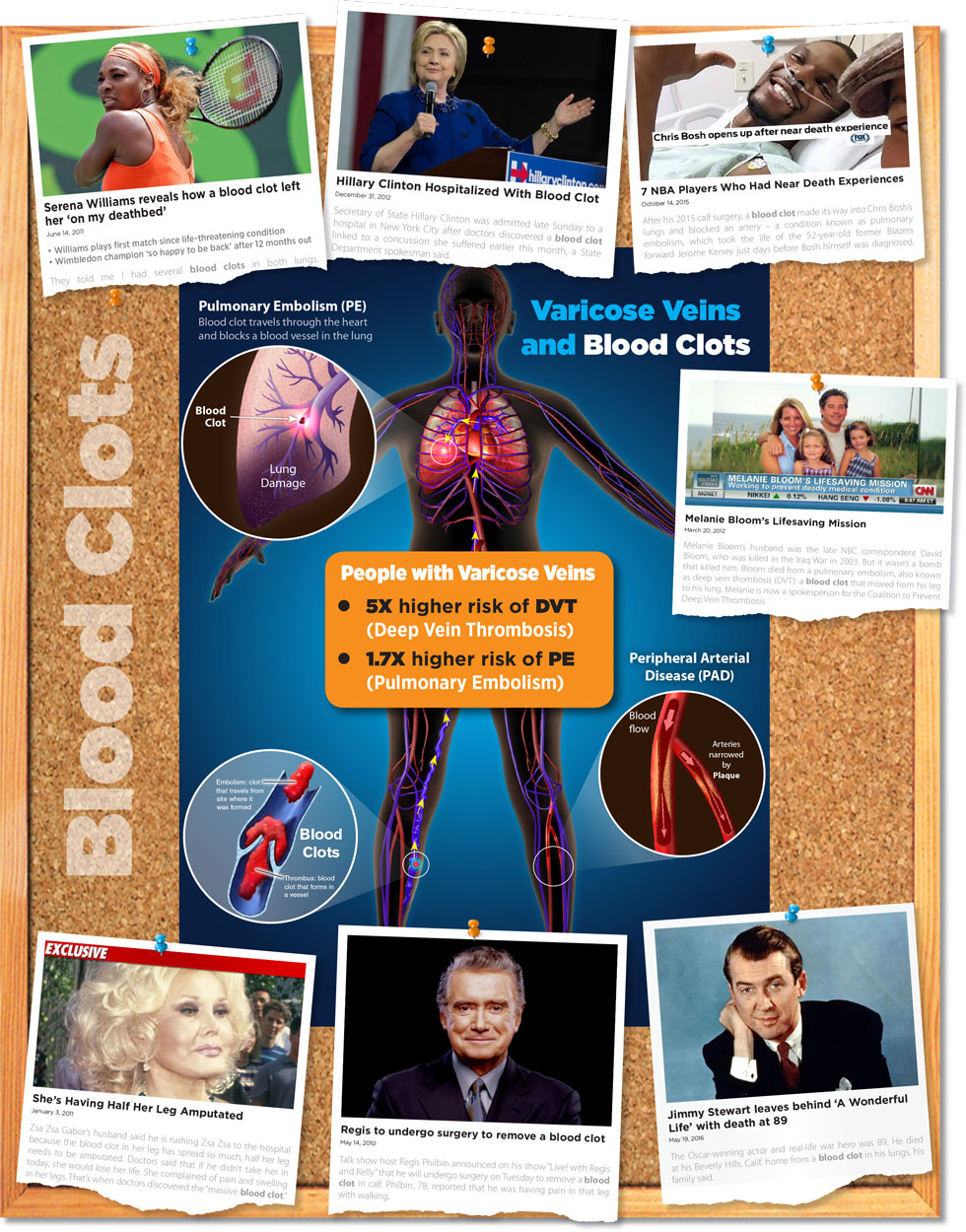

 When your heart beats, it pumps blood through arteries to every part of your body carrying oxygen and essential nutrients. Since you have a limited amount of blood (about 5 liters in an adult), the deoxygenated blood returns to the heart via countless veins in your body. The veins in your legs are farthest from the heart and must work against gravity to push blood back to the heart. Compounded by other risk factors, some veins wear out over time and become “varicose”. The pooling of blood in varicose veins may cause symptoms such as heaviness, tiredness, itching, burning, cramping, restlessness and pain. Left untreated, the increased pressure of blood in the leg veins can leak out, causing problems such as edema, skin discoloration, sores in legs that heal poorly, and frequent skin infections. This condition is called Chronic Venous Insufficiency (CVI).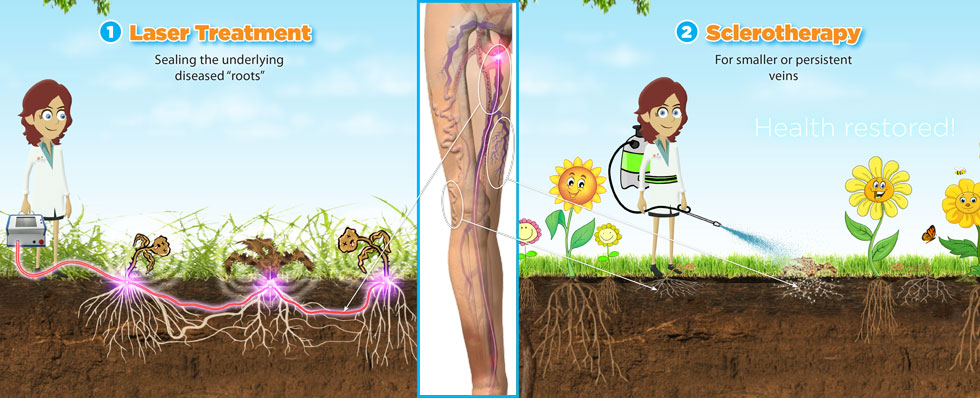

 Even better, the prolonged use of stockings after the procedure is not required. Once sealed, the diseased veins are gradually absorbed by the body. Your Vein Specialist will help you decide if this novel treatment would be suitable for you.